
Equipo Nietzsche
Los Optimizadores
ERPI
"Aún hay que tener caos dentro de sí para poder dar a luz una estrella danzarina."
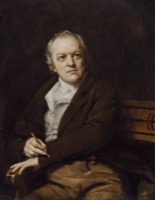
Equipo Nietzsche (ERPI) es Los Optimizadores, un tipo de personalidad epicurean, rationalist, promethean, solitary. Rasgos principales: Intenso, Visionario, Destructivo, Apasionado, Intransigente. Miembros famosos incluyen a William Blake, Ayn Rand, Ludwig van Beethoven. Descubre tu tipo en mypeeps.ai con nuestro test gratuito de 12 preguntas respaldado por investigación científica.
Así Eres Tú
Tú no mejoras las cosas. Las quemas y construyes algo mejor de las cenizas. Donde otros ven tradición, tú ves una jaula. Donde otros ven estabilidad, tú ves estancamiento. Tu destrucción no es imprudente, es la única respuesta honesta a un mundo construido sobre mentiras cómodas.
Sientes todo con máxima intensidad. Tu pasión no es un estado de ánimo, es un método. Razonas desde las entrañas, construyes desde la visión y creas desde un lugar tan profundo y solitario que la mayoría no podría sobrevivir. Pero tú no eres como la mayoría.
La soledad no es una elección. Es una consecuencia. Cuando ves el mundo con la claridad que lo haces, cuando te niegas a aceptar las ficciones reconfortantes que mantienen cómodos a los demás, el aislamiento es inevitable. Pero de ese aislamiento surge el trabajo más honesto y original que jamás se haya visto.
Rasgos
Estás en Buena Compañía





¿Qué te Hace Único?
You are destruction as an act of creation, burning down comfortable fictions to make space for something truer, something harder, something most people aren't brave enough to face. Your Epicurean core means you feel everything at maximum intensity. Your Rationalist wiring means you think from first principles, not precedent. Your Promethean drive means you're never satisfied with the current order. And your Solitary nature means you do all of this alone, because nobody else can keep up.
The tension in your combination is between your passionate nature (Epicurean) and your logical rigor (Rationalist). You feel the injustice AND you can prove why it's wrong. This combination produces ideas that are both intellectually devastating and emotionally compelling, but also ideas that can burn bridges faster than you can build them. Your solitude isn't chosen; it's the natural consequence of seeing the world more clearly than the people around you.
Tus Fortalezas
Unflinching Honesty
You see the world as it actually is, not as people wish it were. This clarity is rare, uncomfortable, and absolutely essential.
Creative Destruction
You don't just critique the existing order: you build something better in its place. Your Promethean-Rationalist combination produces alternatives, not just complaints.
Intellectual Independence
You don't need anyone's permission to think. Your conclusions come from your own reasoning and your own experience, not from consensus or authority.
Passionate Conviction
Your Epicurean core ensures your ideas aren't cold abstractions: they're lived convictions. People follow your ideas because they can feel the truth in them.
Paradigm-Level Thinking
You don't think within systems: you think about systems. Your ability to question the framework itself, not just the details within it, produces genuinely revolutionary insight.
Artistic Vision
Your combination of passion, logic, and solitary depth produces work with an aesthetic quality that transcends mere argument. Your ideas aren't just correct: they're beautiful.
Debilidades Sinceras
Destructive Excess
Your urge to tear down what's broken can extend to things that aren't broken, relationships, institutions, your own achievements. Not everything that's imperfect needs to be destroyed.
Isolating Intensity
Your combination of honesty, intensity, and solitude can push people away. The loneliness isn't the price of genius: it's the cost of refusing to modulate your truth for other people's comfort.
Nihilistic Risk
When your destructive drive outpaces your constructive one, you can spiral into 'nothing matters' territory. Creating must follow destruction, or the destruction becomes its own end.
Emotional Volatility
Your Epicurean intensity means your highs are stratospheric and your lows are abyssal. Without external grounding, the swings can become destabilizing.
¿Cómo tomas decisiones?
A respected institution offers you a position on the condition that you moderate your public positions. You'd decline instantly and write an essay about why the offer itself proves your point. Compromise isn't in your vocabulary when principle is at stake.
Your latest work receives harsh public criticism. Your Epicurean side is wounded; your Rationalist side immediately analyzes whether the criticism has merit. If it does, you'd revise your position, publicly, dramatically, with the same intensity you brought to the original claim.
A close friend adopts a worldview you consider delusional. You can't pretend to agree. You'd tell them exactly what you think, accept the damage, and hope the relationship survives honesty.
Compatibilidad

Same Rationalist-Promethean-Solitary structure, but fueled by duty (Stoic) where you're fueled by passion (Epicurean). Their composure can feel like cowardice to you; your intensity can feel like chaos to them.

Same Epicurean-Rationalist-Promethean fire, but they fight publicly (Agora) where you burn privately (Solitary). They can amplify your ideas to the world.

Same Epicurean-Rationalist-Solitary core, but they refine (Sisyphean) where you create (Promethean). You break; they polish. Different expressions of the same intensity.

Same Epicurean-Promethean-Solitary base, but they observe (Empiricist) where you reason (Rationalist). Their evidence can ground your theory.
Relaciones
You love with devastating intensity and honesty. Your Epicurean passion makes your presence electric; your Rationalist clarity means you see through pretense instantly. The challenge: your honesty can be brutal. You call out the things other people politely ignore, and not everyone can handle that. The growth edge: learning that love doesn't require you to fix or improve the other person. Sometimes presence is enough.
You're the friend who remembers birthdays, plans adventures, and makes people feel special. You collect friends easily because your energy is magnetic. The downside: you can spread yourself thin, maintaining fifty friendships at surface level instead of ten at depth. The friendships that sustain you long-term are the ones where you can be tired and boring and still loved.
Full relationship guide →Carrera y estilo de trabajo
Tu perfil profesional
You belong in roles that require both vision and the courage to destroy, investigative journalism, revolutionary art, critical theory, venture capital (the 'creative destruction' kind), or any field where challenging the established order is the actual job. Avoid institutions that demand conformity, roles that require you to maintain systems you've outgrown, and any workplace where 'the way we've always done it' is considered an argument.
Carreras ideales para ti
Creative direction, brand strategy, or UX design, roles where emotional authenticity and taste drive outcomes, not just data.
Teaching, coaching, or mentorship, work where your contagious enthusiasm becomes someone else's breakthrough. Your energy is a force multiplier.
Entrepreneurship, content creation, or product innovation, environments where passion sustains you through the grind better than a paycheck ever could.
Systems architecture, theoretical research, or strategic planning, work where building mental models is the actual job, not a side effect.
Law, philosophy, or policy design, careers where rigorous reasoning and first-principles thinking produce better outcomes than precedent.
Algorithm design, mathematics, or structural engineering, domains where the elegance of the solution matters as much as whether it works.
R&D, invention, or early-stage startups, environments where creating something that doesn't exist yet is the entire point.
Creative arts, game design, or speculative architecture, work where imagination is the primary tool and constraints are suggestions.
Venture capital, trend forecasting, or innovation consulting, roles that reward spotting what's next before anyone else does.
Software development, writing, or solo research, work where deep focus and uninterrupted thinking produce the best outcomes.
Remote or asynchronous roles, environments where your output matters more than your presence and nobody counts how many meetings you attended.
Forensic analysis, cryptography, or puzzle-solving, careers where the answer reveals itself to the person willing to sit with the problem longest.
Carreras a Evitar
Highly procedural roles in compliance, accounting, or bureaucratic institutions. The repetition will deaden the thing that makes you exceptional.
Toxic hustle culture that confuses burnout with dedication. You need to love the work, 'just push through' isn't in your operating system.
Highly social roles in HR, community management, or customer service where emotional intelligence outweighs logical analysis.
Chaotic startup environments where 'just try it' trumps 'think it through.' You need space to reason before you act.
Maintenance engineering, operations, or support roles where the goal is keeping existing systems running. You'll feel like you're dying slowly.
Heavily regulated industries (banking, healthcare compliance) where innovation requires 18 months of approvals. Your pace and their pace will never align.
Open-plan office cultures with mandatory 'collaboration hours' and team-building retreats. You'll spend more energy managing your exhaustion than doing your work.
Client-facing roles that require constant social performance. You can do it, but it drains the battery that powers your real work.
Tu Estilo de Trabajo
You need meaning in your work, not just a mission statement, actual, daily meaning. You perform best when you believe in what you're building and the people you're building it with. Flexibility matters more to you than hierarchy. You'll take a pay cut to work on something that matters. The danger is chasing novelty when the current work gets hard, build checkpoints that force you to finish before you pivot.
Tú como colega
You're the colleague who raises morale and makes the team actually want to show up. Your enthusiasm is contagious and your emotional intelligence catches problems before they become crises. The trap: you may avoid necessary conflict because it threatens the positive atmosphere you've built. Sometimes the most caring thing is the hard conversation.
Bajo Estrés
Under pressure, you seek escape through stimulation. New projects, new environments, new conversations, anything to replace the heavy feeling with something lighter. This isn't laziness; it's your nervous system's way of self-regulating. The problem is that the thing causing the stress is still there when you come back, and now it's bigger because you've been away.
Your stress recovery superpower is that you're actually good at asking for help, better than most types. Use it. The Epicurean who reaches out to their support system during a crisis recovers faster than the one who tries to distract their way through it. Your emotional honesty is an asset, not a vulnerability. The people who love you want to help, let them.
Under pressure, you retreat into your own head. The world gets too chaotic, so you build increasingly elaborate mental models to contain it. The framework becomes a bunker, safe, logical, completely disconnected from the messy reality outside. You can spend days theorizing about a problem without taking a single concrete action to solve it.
Your stress signal is intellectual arrogance, the quiet conviction that you've already figured it out and execution is someone else's problem. When you catch yourself thinking 'if they'd just listen to me, this would be solved,' pause. That's not clarity; that's stress wearing a mask. The most powerful thing a stressed Rationalist can do is get their hands dirty. Build something, fix something, talk to a real user. Theory without reality-testing becomes delusion under pressure.
Under pressure, you start new things. Project A is stuck? Begin project B. Project B hits a wall? Sketch out project C. Each pivot feels like progress because you're moving, generating, creating, but your energy is fragmenting into smaller and smaller pieces. The pile of 80%-finished work grows while nothing actually ships.
Your stress signal is hyperactivity that produces nothing. You're busy, frantically, impressively busy, but if someone asked what you completed this week, you'd struggle to name one thing. The fix is brutal and simple: pick one thing, finish it, then move on. Write it on a sticky note. Look at it every hour. The Promethean who learns to finish under pressure is more dangerous than any competitor.
Under pressure, you disappear. Messages go unread, invitations get declined, and you retreat so deep into your own space that people start worrying about you. This isn't depression (though it can look like it): it's your nervous system's emergency protocol. You're trying to reduce input to a level you can process. The problem is that the people who could help are the ones you're cutting off.
Your stress signal is radio silence. When the Solitary goes dark, it means the pressure has exceeded their processing capacity. The fix is counterintuitive: reach out before you feel ready. Send a one-line text: 'I'm okay but overwhelmed. Need some space. Will check in Friday.' This buys you the solitude you need while keeping the lifeline intact. Silence worries people; a brief message sets boundaries without burning bridges.
Under pressure, your Promethean side wants to tear down everything that's failing while your Solitary side retreats from anyone who might talk you out of it. The result: scorched-earth decisions made in isolation, without the moderating influence of people who care about you. Your stress antidote: before you burn anything down, run your reasoning past one person you respect. If it still holds after dialogue, proceed. If not, you've saved yourself from your own intensity.
¿Cómo te Comunicas Bajo Presión?
You communicate with your whole self, words, tone, facial expressions, energy. People don't just hear what you're saying; they feel it. This makes you compelling, persuasive, and easy to connect with. You build rapport faster than almost any other type because your emotional transparency signals safety. People trust you quickly because they can see what you're feeling.
In conflicts, you lead with emotion, which is both your gift and your risk. Your honesty cuts through pretense, but it can also escalate situations that needed a cooler approach. The Epicurean who learns to express emotion without being driven by it becomes an extraordinary communicator. Feel everything; say what matters; filter through purpose, not impulse.
You communicate through structure. Your explanations have beginnings, middles, and ends. You define terms, you build from premises, and you arrive at conclusions through visible reasoning. People who think like you find this deeply satisfying. People who don't can feel like they're being lectured rather than talked to.
In conflicts, you try to find the logical core of the disagreement, which is useful but can feel invalidating when the other person's issue is emotional. You can be so focused on 'what's actually true' that you miss 'what's actually wrong.' The Rationalist who learns to validate feelings before restructuring the argument becomes someone people actually want to disagree with, because it always leads somewhere productive.
You communicate through vision. Your natural mode is painting a picture of what could exist, the future, the possibility, the 'imagine if.' This makes you inspiring and sometimes infuriating. People follow your vision when they believe it's achievable, and tune out when it feels like fantasy. The line between the two is details, the more specific you can be, the more persuasive you become.
In conflicts, you tend to leap past the current problem to the solution, which can feel dismissive to someone who needs the current problem acknowledged. 'Okay but here's what we should do instead' can land as 'your feelings about this don't matter.' Slow down. Acknowledge the present before you paint the future.
You communicate through considered, deliberate output. Emails are precise, messages are purposeful, and conversations are efficient. You don't do small talk easily, and you rarely think out loud. What comes out has already been processed, which means your communication is high-quality but low-frequency. People who work with you learn that when you speak, it matters.
In conflicts, you withdraw to process, which can leave the other person feeling abandoned. 'I need to think about this' is responsible, but 'I need to think about this and I'll come back to you by Wednesday' is relationship-saving. The Solitary's communication becomes powerful when it includes timelines and follow-through on the response, not just the retreat.
Reto de crecimiento de 7 días
Small daily actions to build resilience and break your stress patterns.
Monday: Build something instead of critiquing something. Create before you destroy.
Tuesday: Modulate your honesty for one conversation. Practice being kind before being right.
Wednesday: Spend time with someone whose views you disagree with, without trying to change their mind.
Thursday: Notice one thing in the existing order that actually works well. Appreciate it without qualifying it.
Friday: Express vulnerability instead of intensity. 'I'm scared' instead of 'this is wrong.'
Saturday: Do something purely for pleasure, with no philosophical significance. Just enjoy.
Sunday: Write down one relationship you've damaged through excess honesty. Consider whether repair is possible.
Ruta de crecimiento
Address: Destructive Excess
Not everything that's imperfect needs to be destroyed.
Address: Isolating Intensity
The loneliness isn't the price of genius: it's the cost of refusing to modulate your truth for other people's comfort.
Address: Nihilistic Risk
Creating must follow destruction, or the destruction becomes its own end.
Address: Emotional Volatility
Without external grounding, the swings can become destabilizing.
Vida diaria
You communicate with your whole self, words, tone, facial expressions, energy. People don't just hear what you're saying; they feel it. This makes you compelling, persuasive, and easy to connect with. You build rapport faster than almost any other type because your emotional transparency signals safety. People trust you quickly because they can see what you're feeling.
Communication, hobbies, pets & more →Tu rival

Tú destruyes y creas. Ellos perduran y mantienen. Tú ardes en soledad. Ellos lideran en público. Tú razonas desde la visión. Ellos prueban a través de la realidad.
 NEW
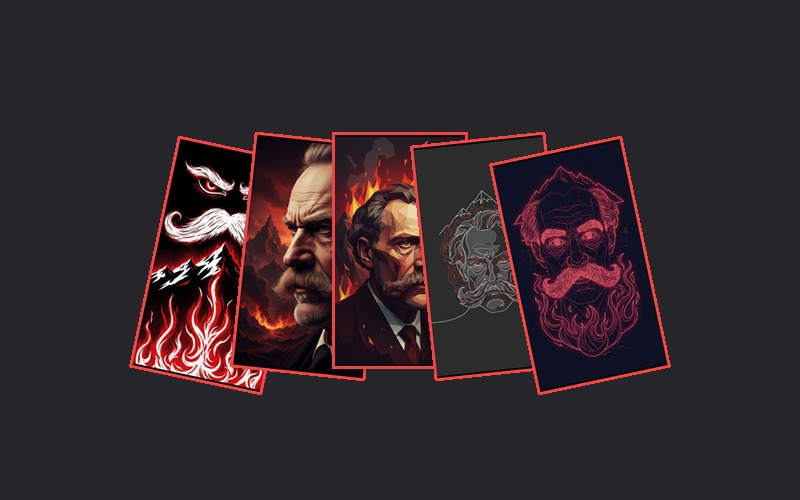
NEW Wallpaper Pack
$266 exclusive phone wallpapers, low-poly, neon blueprint, vintage engraving, minimalist, abstract, and cinematic.
 BEST VALUE
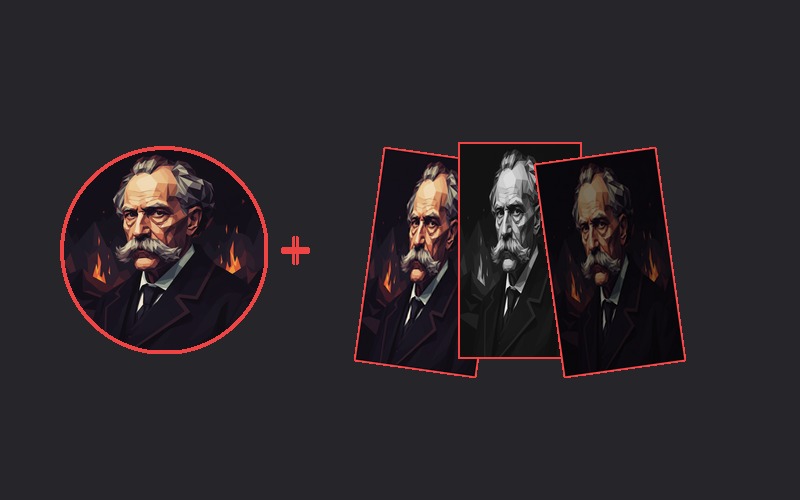
 Complete Bundle
$44Everything: the 24-chapter Deep Dive report + 6 exclusive wallpapers. Best value.
 EXCLUSIVE
 Tarot Card Collection
$496 premium print-quality tarot cards in 6 stunning styles: Dark Botanical, Vintage Woodcut, Minimalist Line, Neon Mystic, Stained Glass, Watercolor Dream. Collector edition.
Pay what you want, starting at $1. Every contribution keeps this quiz free, ad-free, and accessible to everyone. Schools and NGOs get everything at no cost. This is self-knowledge for the people, not profit.
Preguntas Frecuentes
¿Qué tipo de personalidad es Equipo Nietzsche?
Equipo Nietzsche es el tipo Los Optimizadores (ERPI): Epicurean · Rationalist · Promethean · Solitary. Tú no mejoras las cosas. Las quemas y construyes algo mejor de las cenizas. Donde otros ven tradición, tú ves una jaula. Donde otros ven estabilidad, tú ves estancamiento. Tu destrucción no es imprudente, es la única respuesta honesta a un mundo construido sobre mentiras cómodas.
¿Quiénes son miembros famosos de Equipo Nietzsche?
Miembros famosos de Equipo Nietzsche incluyen a William Blake (Visionario intensamente apasionado que construyó cosmologías enteras desde principios internos, en soledad.); Ayn Rand (Construyó un sistema filosófico completo desde primeros principios, derribó el colectivismo.); Ludwig van Beethoven (Creó música radicalmente nueva desde una visión interna, destruyó la convención clásica, profundamente solo.); Soren Kierkegaard (Destruyó sistemas hegelianos desde un intenso principio personal, trabajó en aislamiento existencial.); V (Apasionado, con principios, destruye el orden existente para crear espacio para lo nuevo (V de Vendetta).); Kanye West (Intenso, razona desde una visión personal, derriba y reconstruye géneros.).
¿Cuál es el rival de Equipo Nietzsche?
El rival de Equipo Nietzsche es Equipo Marco Aurelio (Los Ingenieros del Campo). Tú destruyes y creas. Ellos perduran y mantienen. Tú ardes en soledad. Ellos lideran en público. Tú razonas desde la visión. Ellos prueban a través de la realidad.
¿Cómo funciona el test de personalidad?
El test tiene 12 preguntas que mapean 4 ejes binarios con 3 preguntas de elección forzada cada uno. La elección forzada binaria prácticamente elimina el sesgo (d=0.06, Cao & Drasgow 2019). Dos ítems por escala es el mínimo validado para validez de criterio (Crede et al. 2012); usamos tres por eje porque un número impar no puede empatar, así que ningún eje necesita una regla de desempate que favorezca a un polo. Ver nuestra metodología completa. Los resultados son gratuitos, instantáneos y no se requiere email.
Profundiza en Equipo Nietzsche
Conoce las fortalezas y superpoderes de Equipo Nietzsche, descubre con quién es más compatible Equipo Nietzsche y lee la guía completa de relaciones y amor de Equipo Nietzsche.
En el trabajo, explora las mejores carreras para Equipo Nietzsche y entiende cómo Equipo Nietzsche maneja el estrés. Para el día a día, mira a Equipo Nietzsche en la vida cotidiana y conoce a los miembros famosos de Equipo Nietzsche.

Get your full Team Nietzsche report, free
Your Team Nietzsche deep dive: 24 chapters on strengths, blind spots, compatibility, career, money, and stress. One email and it is yours.
One email. One confirmation click and the PDF is yours. No spam, leave anytime.