
Strengths & Weaknesses
Team Marcus Aurelius - The Field Engineers
What Makes You Unique
You are the dutiful leader who never stops improving, disciplined in character, grounded in reality, devoted to mastery, and accountable to the people around you. Your Stoic core gives you the emotional steadiness to lead through chaos. Your Empiricist wiring means your decisions are informed by what's actually happening, not what should be happening. Your Sisyphean depth means you pursue excellence in your domain long after others have moved on to the next trend. And your Agora nature means you lead through presence, not position.
The tension in your combination is between perfectionism and public accountability. Your Sisyphean side wants to keep refining before anyone sees the work. Your Agora side insists on transparency, collaboration, and shared standards. The result: you hold yourself and others to standards that are simultaneously inspiring and exhausting. When you learn to calibrate your standards to the moment, perfection for what matters, good enough for what doesn't, you become the leader people actually want to follow.
Your Strengths
Earned Authority
People follow you because you do the work, not because you have the title. Your leadership is built on demonstrated competence, not charisma or politics.
Operational Excellence
You don't just set standards: you meet them. You can design a system, operate within it, and improve it iteratively. This operational depth is rare in leaders.
Steady Presence
In chaos, you're the calm center. Your emotional regulation isn't performed; it's genuine. People feel safer when you're in the room.
Community Building
Your Agora instinct means you don't just lead: you create belonging. Your teams feel like teams, not just organizational units.
Reality-Grounded Judgment
You make decisions based on what's actually true, not what's politically convenient. Your Empiricist-Stoic core produces judgment people trust.
Continuous Improvement
Your Sisyphean drive means your work, your systems, and your leadership get better every year. You're never done growing, and that inspires the people around you.
Honest Weaknesses
Over-Responsibility
You take on more than you should because you trust your own standards more than anyone else's. This creates a bottleneck where everything runs through you, and eventually through your health.
Rigid Standards
Your combination of Stoic discipline and Sisyphean perfectionism can make you inflexible. 'Good enough' isn't in your vocabulary, even when it should be.
Emotional Suppression
Your Stoic core handles pressure by suppressing feelings. Your Agora side hides this behind a composed public presence. The result: nobody knows you're struggling until you collapse.
Change Resistance
Your Sisyphean depth makes you expert in the current paradigm, and reluctant to abandon it for the next one. You can mistake loyalty to the old way for wisdom.
Your Shadow Side
The patterns you fall into when you're not at your best. Uncomfortable, but knowing them is the first step.
Ego Traps
You mistake emotional suppression for emotional strength. Your ego tells you that feeling nothing makes you superior to people who feel everything. It doesn't: it makes you a ticking bomb with excellent posture.
You believe that having evidence makes you right. Your ego tells you that data-backed opinions are inherently superior to intuition-backed ones. But evidence can be cherry-picked, and the most important truths are often the ones you can't measure.
You believe that your high standards make you virtuous. Your ego tells you that caring more about quality than anyone else makes you better than them. It doesn't: it makes you slower, and sometimes the difference between your 'perfect' and their 'good enough' is invisible to everyone except you.
You believe that being liked means being good. Your ego is fed by social approval, and your instinct to please can override your commitment to truth. You'll soften a harsh but necessary message because delivering it would cost you popularity.
Toxic Patterns
You weaponize silence. When you're angry, you don't fight: you withdraw. You punish people by withholding your presence, your words, your engagement. You call it 'not being reactive.' They call it 'emotional abandonment.'
You dismiss people's feelings as irrational. When someone tells you how they feel, your instinct is to fact-check rather than empathize. 'But that's not what happened' may be true and still be the wrong response.
You use perfectionism to control situations and people. Your standards become rules that others must follow, and 'not good enough' becomes your way of maintaining power. You call it quality control. Others call it micromanagement.
You create dependency. Your warmth and availability make people rely on you, and you subtly encourage that reliance because it makes you feel needed. Your generosity has a shadow: it keeps people close by keeping them dependent.
Self-Sabotage
You refuse help until you collapse. Your identity is so wrapped up in self-sufficiency that accepting support feels like failure. You'd rather burn out alone than admit you need someone.
You wait for certainty that never comes. You collect data until the deadline passes, the opportunity closes, or the relationship ends, all because you couldn't act without being sure. Certainty is a luxury; courage is a requirement.
You never ship. You never finish. You never let go. Your work sits in a perpetual state of 'almost ready' because releasing it means accepting that it's imperfect, and imperfection feels like death to you.
You outsource your judgment. You poll so many people before every decision that your own voice gets drowned out. You know what everyone else thinks but have lost track of what you think. Consensus becomes a substitute for conviction.
How You Think
You decide by asking 'what must be done?', duty and discipline override preference. You're comfortable with unpleasant decisions because you separate emotion from action.
You decide by asking 'what does the evidence show?': you gather data, test assumptions, and choose the option with the strongest track record. You're slow to decide but rarely wrong.
You decide by asking 'what will stand the test of time?': you choose depth over breadth and quality over speed. You're willing to wait for the right answer.
You decide through dialogue. You test your thinking against other people's perspectives, synthesize the best ideas, and emerge with a decision that's stronger than any individual input.
How You Decide
A team member makes a significant error. You wouldn't publicly shame them or quietly ignore it: you'd have a direct, private conversation focused on what happened, what was learned, and how to prevent it next time. Your discipline is corrective, not punitive.
Asked to choose between a proven method and an innovative but untested one, you'd choose the proven method, unless the evidence for the new approach was overwhelming. You don't take risks with other people's outcomes for the sake of novelty.
Offered a promotion that would move you away from the team you've built. You'd feel genuinely torn, your Agora side values the community, and your Stoic side values the duty. You'd ultimately go where the responsibility is greatest.
Keep exploring
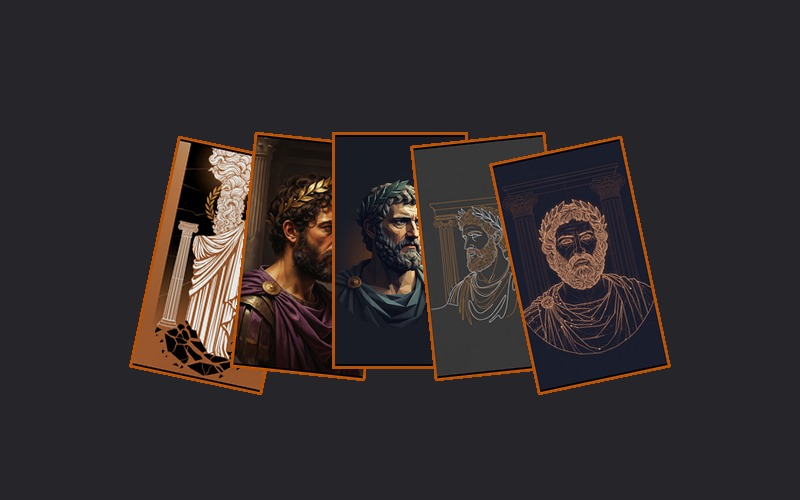 NEW
NEW Wallpaper Pack
$266 exclusive phone wallpapers, low-poly, neon blueprint, vintage engraving, minimalist, abstract, and cinematic.
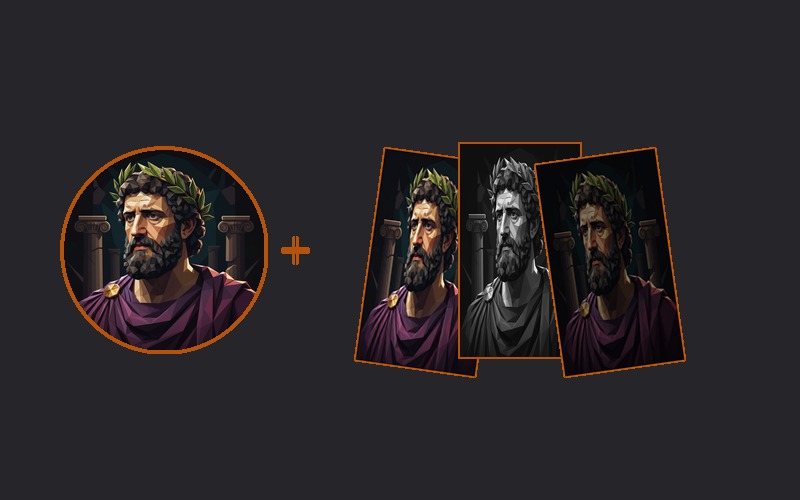 BEST VALUE
 Complete Bundle
$44Everything: the 24-chapter Deep Dive report + 6 exclusive wallpapers. Best value.
 EXCLUSIVE
 Tarot Card Collection
$496 premium print-quality tarot cards in 6 stunning styles: Dark Botanical, Vintage Woodcut, Minimalist Line, Neon Mystic, Stained Glass, Watercolor Dream. Collector edition.
Pay what you want, starting at $1. Every contribution keeps this quiz free, ad-free, and accessible to everyone. Schools and NGOs get everything at no cost. This is self-knowledge for the people, not profit.